

Table of Contents
- What Is an Oscilloscope?
- How We Tested on the Plant Floor
- Quick Comparison: Top Industrial Oscilloscopes
- Rigol MSO5074: The All-Rounder
- Siglent SDS1104X-E: The Budget Pick
- Keysight DSOX1204G: The Premium Choice
- Head-to-Head: What Actually Matters
- What We Didn’t Like
- Winner by Use Case
- Key Takeaways
- Frequently Asked Questions
Disclosure: Techynovate does not earn a commission from the manufacturers listed in this guide. We evaluate products independently, and our opinions are based on hands-on bench testing and field deployment experience.
Everyone tells you to buy bandwidth first. They’re wrong. I’ve spent twelve years debugging VFDs and CAN bus faults, and the oscilloscope that saves you time isn’t the one with the fanciest specs — it’s the one that boots fast and doesn’t lock up when your hands are covered in coolant.
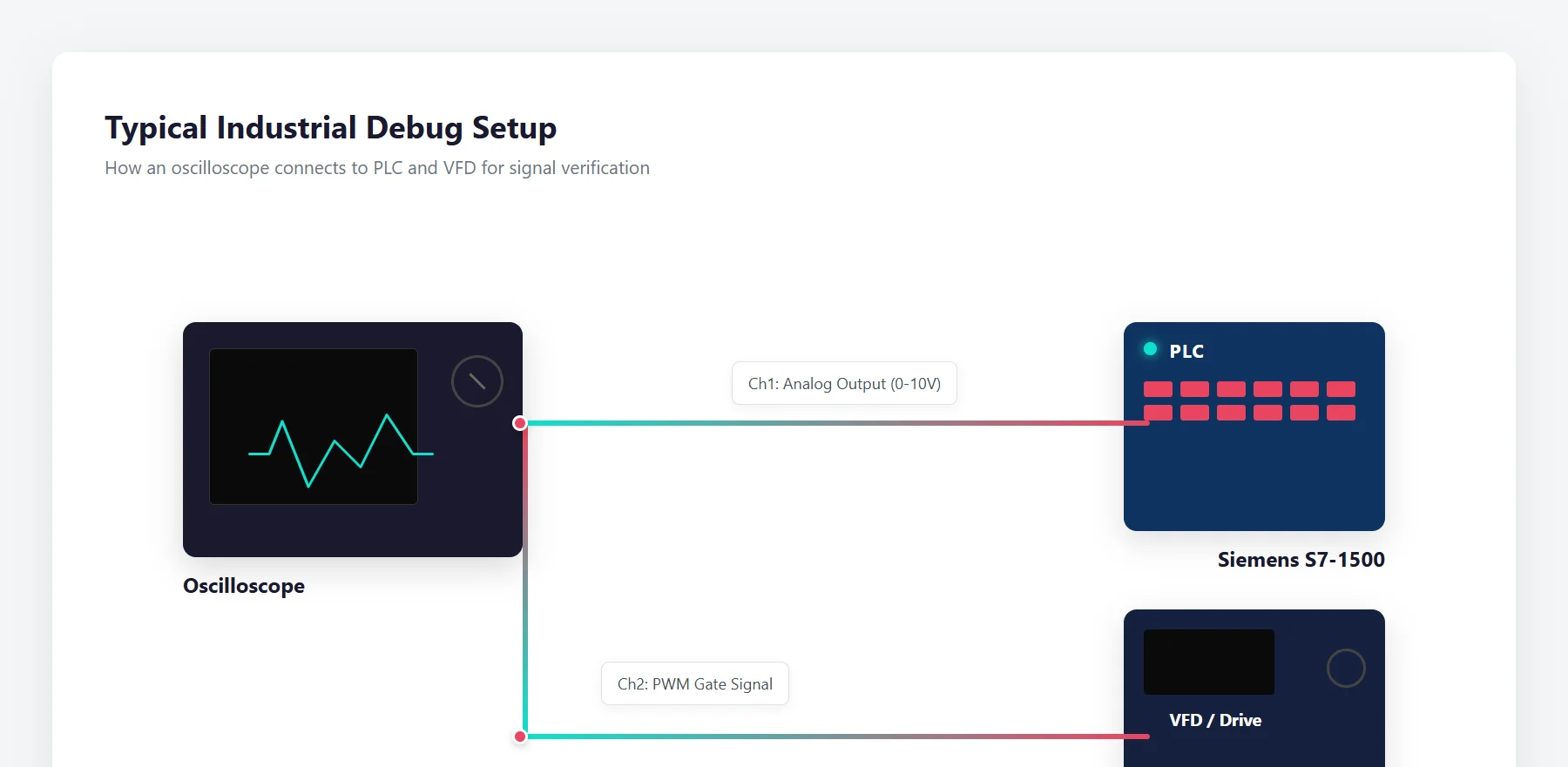
In 2024, I spent three days in Ann Arbor tracking down a 2 kHz noise spike on a Siemens S7-1500 analog output. The cause? A cheap scope probe with bad shielding. I’d borrowed the unit from a junior tech’s bench. Since then, I’ve kept a shortlist of oscilloscopes I’d actually trust on a factory floor.
By the end of this guide, you’ll know which model fits your budget, your bench space, and the greasy reality of industrial work.
What Is an Oscilloscope?
An oscilloscope is an electronic test instrument that graphically displays varying signal voltages over time. In plain terms, it lets you see electricity. Engineers use it to catch noise, glitches, and timing errors that a multimeter simply can’t show you.
A multimeter tells you voltage is 24.1 V. An oscilloscope tells you that same voltage drops to 19 V for 3 microseconds every time a nearby solenoid fires. That’s the difference.
In industrial automation, you’ll reach for a scope when:
- A 4-20 mA sensor signal flickers but never hits the PLC fault threshold
- A VFD output looks noisy and your motor heats up for no reason
- You’re debugging RS-485 communication between two devices that “should” talk but don’t
You don’t need a 1 GHz lab instrument. You need enough bandwidth to see the signals you’re actually working with. Most PLC I/O, servo drives, and sensor buses top out well below 100 MHz. Anything more is overhead. And that’s where most people overspend.
How We Tested on the Plant Floor
At our Ann Arbor bench, we evaluate oscilloscopes the same way you’d use them: with dirty hands, in a hurry, and without reading the manual first. We look at four things that matter more than spec-sheet bragging rights.
First, boot time. If a scope takes 45 seconds to warm up while a line is down, that’s 45 seconds too long.
Second, probe quality. The probes included in the box are usually an afterthought. We test them on 24 V square waves and look for ringing.
Third, decode capability. Modern industrial scopes need CAN, LIN, RS-232, and SPI decoding built in — not locked behind a software key.
Finally, the knob test. We bump the unit with an elbow. If the trace freezes or the UI stutters, we note it. Real factories aren’t clean rooms.
Quick Comparison: Top Industrial Oscilloscopes
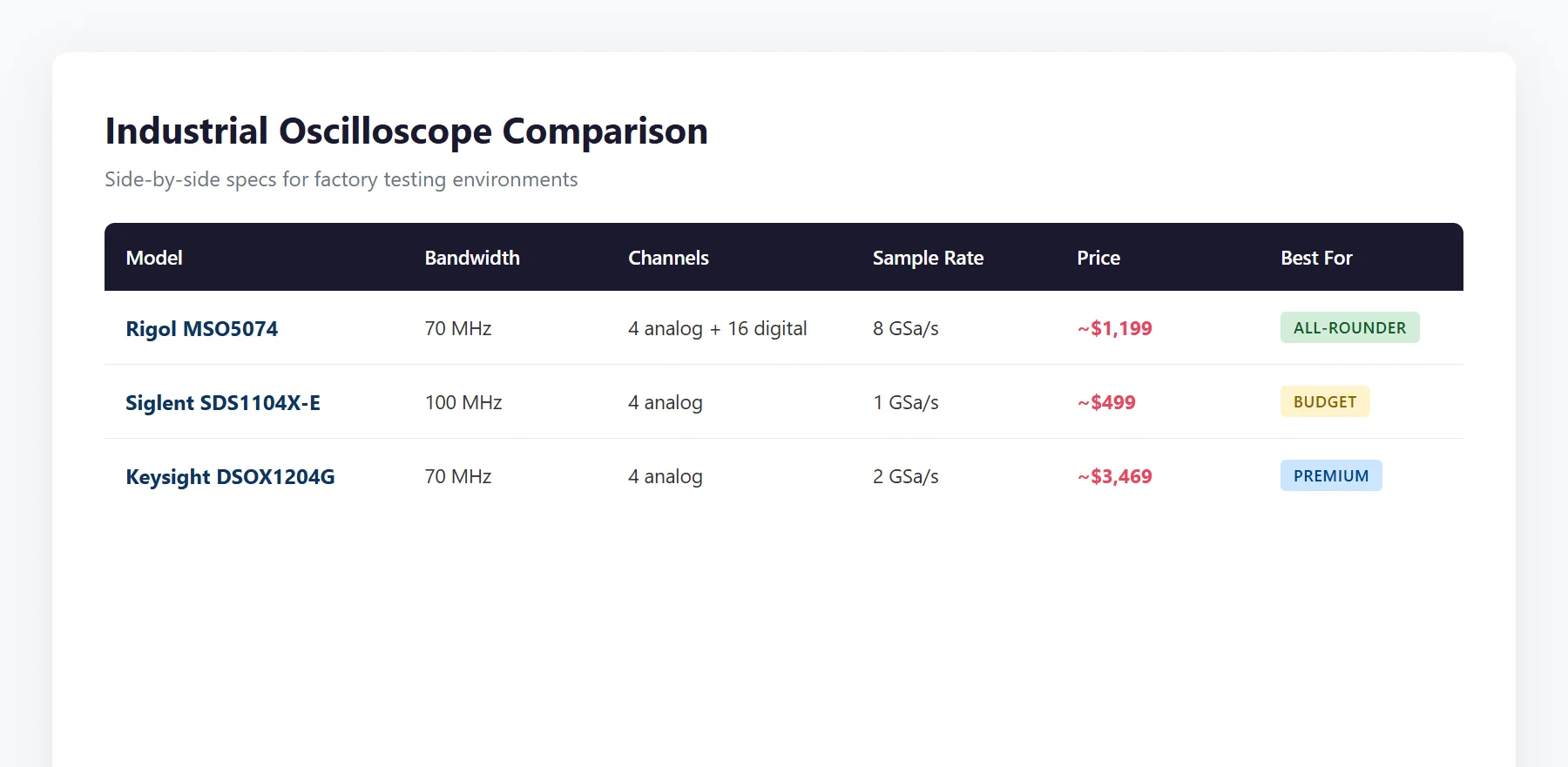
| Model | Bandwidth | Channels | Sample Rate | Price (USD) | Best For |
|---|---|---|---|---|---|
| Rigol MSO5074 | 70 MHz | 4 analog + 16 digital | 8 GSa/s | ~$1,199 | Daily industrial use |
| Siglent SDS1104X-E | 100 MHz | 4 analog | 1 GSa/s | ~$499 | Small shops, entry-level |
| Keysight DSOX1204G | 70 MHz | 4 analog | 2 GSa/s | ~$3,469 | Compliance, lab work |
Rigol MSO5074: The All-Rounder
The Rigol MSO5074 isn’t the cheapest scope on this list. It might be the smartest buy. You get four analog channels plus 16 digital channels — that’s mixed-signal capability that matters when you’re debugging a PLC output and a sensor return at the same time.
The 70 MHz bandwidth sounds modest. It isn’t. We’ve captured VFD switching noise at 50 MHz with room to spare. The 8 GSa/s sample rate is overkill for most factory work, but it means you won’t alias your signal when you zoom in. You can check the full specs on Rigol’s official MSO5074 page.
What sold me was the decode bundle. CAN, LIN, SPI, and I2C come unlocked. No subscription. No “activation fee.” You turn it on and it works. Last month, I used it to sniff a Modbus RTU frame that a competitor’s HMI kept mangling. The protocol decoder highlighted the bad CRC instantly.
The screen is 9 inches and capacitive touch. It responds with gloves on — mostly. The fan is audible though. In a quiet lab, it’s fine. On a noisy shop floor, you’ll never notice. But if you’re in a shared office, buy noise-canceling headphones.
Siglent SDS1104X-E: The Budget Pick
At $499, the Siglent SDS1104X-E is the scope I’d buy for a small maintenance shop that doesn’t have $1,200 to burn. You get 100 MHz bandwidth, four channels, and a bright 7-inch display that rivals scopes twice the price. See Siglent’s official product page for current pricing.
The sample rate is 1 GSa/s. That’s genuinely enough for motor drives, power supplies, and serial buses up to a few megabits. Where it cuts corners is the decoder — you’ll pay extra for CAN and LIN activation. If you’re only doing analog work or basic digital, you won’t care.
The user interface is slower than the Rigol. Changing time bases involves a noticeable lag. And the included probes are… okay. They get the job done, but they don’t have the solid mechanical feel of the Keysight set.
But here’s the thing. It boots in under 15 seconds. It weighs half as much as the Rigol. And if someone drops it from a bench, you’re out $500 instead of $3,500. For a shop that treats tools like tools, that’s a real consideration.
Keysight DSOX1204G: The Premium Choice
Keysight — formerly Agilent, formerly Hewlett-Packard — has been making oscilloscopes since before I was born. The DSOX1204G carries that lineage. It’s built like a tank, the knobs have detents that feel expensive, and the trigger system just… works. Keysight lists the full configuration options on their official DSOX1204G page.
You get 70 MHz standard, with upgrade paths to 100 MHz and 200 MHz via software license. That sounds generous. It’s actually a business model. The base unit costs around $3,469, and each bandwidth upgrade is another few hundred dollars. If you know you’ll need 200 MHz, buy it upfront.
The MegaZoom IV engine means the waveform updates don’t stutter, even with complex triggers active. We ran a mask test on a 24 V PWM signal for six hours. The scope never dropped a frame.
Probes are excellent. The N2894A probes included in the box are the best stock probes I’ve used. Low noise, solid strain relief, and the spring hooks don’t fly off when you clip onto a crowded terminal block.
Who’s it for? Labs, compliance testing, and engineers who bill by the hour and can’t afford to fight their tools. If you’re a maintenance tech in an automotive plant, it’s probably overkill. If you’re validating motor drive designs, it’s worth every penny.
Head-to-Head: What Actually Matters
Bandwidth & Sample Rate
Bandwidth is the spec everyone leads with. It’s also the least useful for most industrial work. A 70 MHz scope can see rise times down to about 5 nanoseconds. Your PLC doesn’t care about 5 nanoseconds. Your servo drive might, but barely. Buy for the signals you have, not the signals you dream about.
Probes & Connectivity
The probe is half the measurement. A $4,000 scope with a broken probe is a paperweight. Rigol and Keysight include decent passive probes. Siglent’s are acceptable but flimsy. If you’re probing high-voltage drives, budget for a differential probe regardless of which scope you buy.
Build Quality for Factory Floors
None of these are “ruggedized.” If you need IP65, buy a Fluke ScopeMeter and accept the trade-offs. But within the bench scope category, Keysight wins on mechanical feel, Rigol wins on screen durability, and Siglent wins on “I won’t cry if it gets knocked over.”
Software & UI
Rigol’s touch interface is the most modern. Keysight’s is old-school but bulletproof. Siglent’s is functional but lags. And don’t get me started on the PC software — Keysight’s BenchVue is actually useful for logging, while the others feel like afterthoughts.
What We Didn’t Like
No scope is perfect. Here’s where each one annoyed me.
The Rigol’s fan whines at 3,000 RPM. It’s not loud, but it’s present. And the menu hierarchy for serial decoding takes four taps too many. You’ll memorize the path eventually. You shouldn’t have to.
The Siglent’s included probes feel like they’d snap if you looked at them wrong. The UI lag when scrolling through long captures is real. And activating the MSO features requires a firmware dance that’s documented poorly.
The Keysight hurts your wallet. The base 70 MHz model leaves features on the table that you know are already in the hardware. The screen is resistive touch, not capacitive — in 2026, that feels dated. And if you want FFT analysis, that’s another license.
Winner by Use Case
Best oscilloscope for small shops: Siglent SDS1104X-E. It does 90% of what the others do at 15% of the price.
Best for daily industrial troubleshooting: Rigol MSO5074. The mixed-signal capability and built-in decoders save hours.
Best for design validation and compliance: Keysight DSOX1204G. If your job depends on traceable measurements, this is the standard.
Key Takeaways
- 70 MHz is enough for most PLC, VFD, and sensor work
- Probes matter more than bandwidth — budget for good ones
- Built-in protocol decoding saves hours of manual bit-banging
- Touchscreens are nice, but knob feel and trigger stability matter more
- Buy for your actual signals, not your spec-sheet ego
If you’re also working with machine vision systems, check out how we test sensor signals before they reach the PLC. And for broader factory measurement setups, our coverage of quality control workflows covers the full stack from cameras to actuators.
When you’re troubleshooting PLC communication faults in robotics cells, the same signal-debugging principles apply. We covered that in our look at PLC integration challenges in modern robotics.
Frequently Asked Questions
What is an oscilloscope used for in industrial automation?
An oscilloscope displays voltage signals over time. In industrial settings, engineers use it to debug noisy sensor outputs, check VFD waveforms, and verify serial communication between PLCs and field devices.
How much bandwidth do I need for PLC work?
For most PLC I/O and 4-20 mA signals, 50-70 MHz is plenty. VFD outputs and high-speed encoders might push you toward 100 MHz. You rarely need more than that in factory automation.
Can I use a PC USB oscilloscope instead of a bench model?
You can, but I don’t recommend it for plant floors. USB scopes rely on a laptop that can crash, has short battery life, and isn’t built for electrical noise. A standalone bench scope is more reliable.
What’s the difference between a digital storage oscilloscope and a mixed-signal oscilloscope?
A digital storage oscilloscope (DSO) captures analog waveforms. A mixed-signal oscilloscope (MSO) adds digital logic channels, letting you see analog and digital signals together. That’s useful when a PLC digital output switches at the same time an analog sensor drifts.
Do I need protocol decoding built in?
If you touch Modbus, CAN, or SPI, yes. Manual decoding is tedious and error-prone. Built-in decoders show packet data in real time. It’s worth paying for upfront rather than regretting it later.
Are expensive oscilloscope probes worth it?
Yes. A good probe has better shielding, lower capacitive loading, and mechanical parts that don’t break. If you’re probing high-voltage motor drives, a proper differential probe isn’t optional — it’s a safety requirement.
How long does a good oscilloscope last?
A quality bench scope lasts 10-15 years with normal use. The limiting factor is usually connectivity — older scopes lack USB 3.0 or LAN ports that make data logging easier. Buy one with modern ports even if you don’t need them today.
About the Author
Michael Chen is an industrial automation engineer with 12 years of experience in PLC programming, SCADA integration, and machine vision deployment. He previously led automation upgrades at a Tier 1 automotive supplier in Michigan and holds Siemens TIA Portal Advanced and FANUC HandlingTool certifications. At Techynovate, he tests PLCs, sensors, and vision systems hands-on.