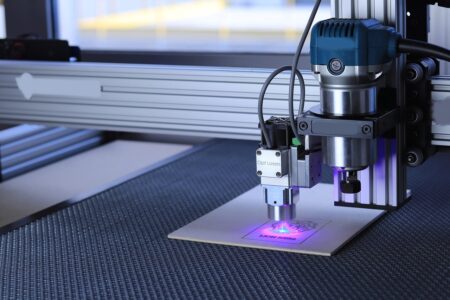

I follow cnc robotics news for the same reason a lot of machinists do: we’re trying to figure out if our jobs are safe. Not in a dramatic way. Just… practically. CNC machines have been around forever. Robots have been around forever. But seeing them work together on a shop floor? That’s relatively new. And it’s changing faster than most people realize.
I visited a machine shop in Pennsylvania three months ago. Twelve CNC mills, eight lathes, two dozen employees. The owner had just installed a robotic arm to tend one of his mills. I watched it load a raw aluminum block, wait for the cycle to finish, then pull the finished part and place it in a tray. Over and over. Perfectly. At 2 AM, while everyone was home. He told me it paid for itself in fourteen months. Not because it was faster than a human. But because it let him run that machine unattended on a second shift he couldn’t staff.
Look, the cnc robotics news headlines make it sound like robots are replacing machinists. In reality, they’re replacing the boring parts. Loading. Unloading. Deburring simple edges. Moving parts between machines. The skilled work — programming complex geometry, choosing feeds and speeds, troubleshooting bad surface finishes — that’s still human. At least for now.
What CNC Robots Actually Do on Shop Floors
I asked five shop owners what their robots actually handle. The answers were surprisingly consistent. First, machine tending. Loading raw stock, removing finished parts. That’s 70% of what CNC robots do. Second, part transfer. Moving a partially machined part from one station to another. Third, simple quality checks. Placing a part under a vision camera to verify dimensions. Fourth, deburring and cleaning. Not complex finishing — just removing burrs from drilled holes or washing off coolant.
What they DON’T do? Program the CNC. Decide tooling strategy. Fix a chatter problem on a deep pocket. Respond to a dimensional drift mid-batch. A robot can execute. It can’t troubleshoot. That’s the line, and it’s not moving as fast as the headlines suggest.
I saw a demo once where a robot tried to load a slightly warped casting into a fixture. The human operator would have felt the resistance, adjusted the angle, and seated it properly. The robot? It applied force, scratched the part, and set off an alarm. Some tasks require touch. And touch is expensive to replicate.
The Numbers That Actually Matter
A decent CNC tending robot — arm, gripper, vision, safety cage — runs about $80,000 to $120,000 installed. That’s not cheap for a small shop. But compare it to a human operator at $22 per hour plus benefits, working two shifts. The payback is roughly 18 to 24 months if you’re running unattended nights and weekends. The real value isn’t speed. It’s capacity. A robot doesn’t call in sick. It doesn’t take breaks. It doesn’t quit because another shop offered $2 more per hour.
The shop owner in Pennsylvania told me something I hadn’t considered. Before the robot, his best mill sat idle for ten hours every night. After the robot, it produced parts while he slept. His revenue went up 30% without hiring anyone new. That’s the business case most cnc robotics news stories miss. It’s not about replacing people. It’s about utilizing expensive machines that were already sitting there doing nothing.
I recall seeing a market report last year — I think from Interact Analysis — that put the CNC tending robot market at about $1.2 billion in 2024. Growing 15% annually. Most of that growth is in automotive and aerospace, where batch sizes are large and parts are heavy. Small job shops? Adoption is slower. Way slower.
The controller is what actually runs the robot, but without a solid CNC program behind it, the whole system is just expensive choreography. Both need to be right.
What I Got Wrong About CNC Robots
I’ll admit it. I thought CNC robots were only for massive factories. Like, hundred-machine shops. Turns out, that’s not true anymore. Collaborative robots — the ones that don’t need cages — have made automation accessible to shops with five or ten machines. A cobot tending a CNC lathe is now a realistic option for a 20-person shop. That wasn’t the case five years ago.
But I also got the programming wrong. I figured setting up a robot to tend a CNC would be plug-and-play. It isn’t. You need to program the robot’s path. Define grip points. Handle exceptions. What happens if the part isn’t seated right? What if a chip blocks the fixture? What if the coolant nozzle sprays the robot’s camera? These edge cases take hours to map out. Days sometimes.
For technical background, computer numerical control basics on Wikipedia explain how CNC systems work. And robotics market outlook from Statista puts these trends in the bigger picture.
Machine vision is what lets robots verify parts without human eyes, and that combination is getting cheaper every year.
Frequently Asked Questions
Are CNC robots replacing machinists?
Not really. They’re replacing repetitive loading and unloading tasks. The programming, setup, troubleshooting, and complex decision-making still need humans. Most shops that add robots redeploy machinists to higher-skill work rather than eliminate positions.
How much does a CNC tending robot cost?
A full system — robot arm, gripper, safety equipment, integration — typically runs $80,000 to $120,000. Collaborative robots on the lower end, traditional industrial robots on the higher end. Integration labor can add another $10,000 to $30,000.
Can small shops afford CNC robots?
Collaborative robots have made it possible. A cobot tending a single machine might cost $40,000 to $60,000. For a shop running unattended shifts, the payback is usually under two years. Financing and leasing options are also widely available now.
Do CNC robots work with existing machines?
Mostly yes, but integration matters. Older CNC machines may lack the communication interfaces robots need. Modern machines with Ethernet/IP or OPC-UA make integration easier. Always check your machine’s I/O and communication capabilities before buying a robot.
What’s the biggest challenge with CNC robotics?
Programming the edge cases. The happy path is easy. But handling dropped parts, misaligned stock, tool changes, and alarm conditions takes real engineering effort. Shops often underestimate this part.
Where can I find reliable cnc robotics news?
I read Modern Machine Shop, Manufacturing Engineering, and The Robot Report. Trade shows like IMTS and Automate also generate a lot of real-world case studies. Reddit’s r/machinists has surprisingly honest opinions too.
When the Machinist Became the Robot Tech
Mike had been running a vertical machining center for fourteen years when we installed a collaborative robot to load blanks. He was convinced it was the first step toward replacing him. For two weeks, he barely looked at the robot. Then a misload happened because the gripper fingers were worn, and the robot threw an alarm. Maintenance was backed up. Mike cleared the fault, adjusted the gripper alignment, and restarted the cycle. By the end of the month, he was tweaking the robot program to handle a new part geometry faster than the integrator could have.
That transition is happening everywhere. The machinists who grew up understanding tooling, fixtures, and material behavior are the exact people who should be programming robots. They already know the process. What they need is exposure to the control environment. Our best robot programmers are former manual machinists who learned by experimenting after hours.
The fear of replacement is understandable, but it is mostly wrong. Robots in CNC cells handle the repetitive loading and unloading. The human still decides tooling strategies, troubleshoots surface finish issues, and optimizes feeds and speeds. A robot cannot feel chatter. A robot cannot look at a chip and know the insert is dull. Those senses take years to develop.
Skills That Transfer Directly
Fixture design. A machinist who understands how to hold a part for cutting also understands how a robot needs to grip it for loading. The same principles of rigidity, accessibility, and repeatability apply.
Process timing. Knowing how long a cut takes, when coolant is needed, and how to avoid thermal expansion — these are the same inputs a robot scheduler needs.
Problem diagnosis. When a robot misloads, the root cause is rarely the robot itself. It is usually a dimensional variation in the raw blank, a worn gripper, or a programming point that drifted. Machinists are already trained to look for root causes, not symptoms.
If you have machinists who are worried about automation, give them access to the robot pendant. Let them break things in a safe environment. The ones who figure it out will become your most valuable operators.
The Collision That Almost Happened
We had been running the new robotic cell for three weeks without incident when a tool setter malfunctioned. The robot approached the CNC door with a blank while the spindle was still spinning at 4,000 RPM. The interlock should have caught it. It did not. The only reason we avoided a catastrophic crash was a secondary light curtain that our safety engineer had insisted on installing despite the integrator saying it was unnecessary. That light curtain cost $900. A new spindle would have cost $18,000.
That moment redefined how I think about CNC robotics. The robot is not the risk. The interface between the robot and the machine is the risk. Every handoff point — door open, chuck clamp, spindle stop — needs redundant verification. Not because the first sensor will fail. Because someday it will, and you will not know until it is too late.
I now require every integration to include a risk assessment matrix that identifies every possible collision scenario. It is tedious. It slows down commissioning by a day or two. But it also means I sleep through the night instead of waiting for a 3 a.m. phone call about a destroyed spindle and a robot arm bent like a pretzel.
Where I See This Going
In five years, I believe most new CNC machines will ship with native robotic interfaces. The old days of custom integration for every cell will fade. Machine builders will pre-engineer robot mounting points, pre-program standard loading sequences, and offer certified integration packages. That shift will make CNC robotics accessible to shops that cannot afford a dedicated integrator today. The shops that start learning now will be the ones ready to scale when that wave hits.
If you are a machinist reading this and feeling uneasy about robots, I get it. I felt the same way. But the reality is that CNC robotics creates more interesting work, not less. The people who embrace it early will write the programs. The people who resist will be left watching someone else do it. Choose the side you want to be on.
The future belongs to those who adapt early. Start today.